We have found our articles and begun to read them and summarize them. We have broken up the articles so each of us read ~5-6 articles. We have also started looking for an interactive activity for the class to do and have a short list of about 5-6 questions/activities. We have also begun thinking about who we will contact for our community reach moving forward. I think each of us have someone in mind and will continue to report back to each other through a chat we've made
Thursday, 19 November 2020

Thursday, 12 November 2020
Exit Slip #8 - Class Discussion

Entrance Slip #7 - Permitting Creativity in Science

Indeed, if no one followed up on original ideas, we would be buried in fresh starts going nowhere. I think this is a really interesting idea, and one that we continually see in the STEM areas of learning. If we were to take everything for face value when it was first discovered, we would never progress and always be reliving the past. Part of the fun of science and mathematics is exploring theorems and formulas that were brought up from the past and linking them to new ideas and bridging them in ways that ancient mathematicians wouldn't think possible when they first discovered them. it is also the catalyst for improvement, change, and exploration. Finding and creating theories takes time and patience, and we cannot be scared to continue to progress with our own ideas, even if we fail. If we do fail, we can still learn from these experiences and bridge that knowledge to other ideas to continue to learn and grow. Learning is a never ending process unless we give up and stop following our ideas.
We have many ways of dismissing new observations, of explaining them away as if our goal were to be rid of them as quickly as possible...If those fail, then another pair of techniques will succeed for sure. Connecting to the previous point, this is very interesting because I find it analogous to politics and conspiracy theorists. In the digital age, where ads are targeted and tailored towards our individual desires, we are pumped full of information that continually attempts to validate our beliefs. Videos that are recommended, ads online, and 'explore' pages on social media all target the person's beliefs and enhance them to the point where they cannot accept another point of view. I think this is such a dangerous belief that goes beyond science and is dividing our world apart. In politics (especially in America) the divide between left and right wing politics have never felt greater, and it only continues to grow. Neither side is willing to agree with the other or even meet halfway and come to an agreement. We are constantly trying to validate our own beliefs and say that failure or the opposite of what we want is acceptable.
Analogies form a bridge to the ultimate necessity, words. I found this really interesting because my SA has mentioned the same things and has tried implementing this idea into her classroom. Math has some extremely technical and confusing terms that anyone would find hard to understand, so how can we expect 13 year-olds to pick it up right away? Formal definitions are important, but having them understand through visual representations or analogies from their daily life can really help them understand the ideas more seamlessly. I found that using analogies that are within the classroom really helps the students understand visually; for example I used a box found in the room to help communicate 3D objects, nets, and surface area and mentioned how if the students were ever stuck, they could always refer to that example. Some analogies can be personal to the student like using sports as an analogy to angles, or they could be general like the box idea. Either way it gives the students words to technical meaning and makes translation on the teachers' part easier.
Tuesday, 10 November 2020
Women, the Nobel Prize and Physics
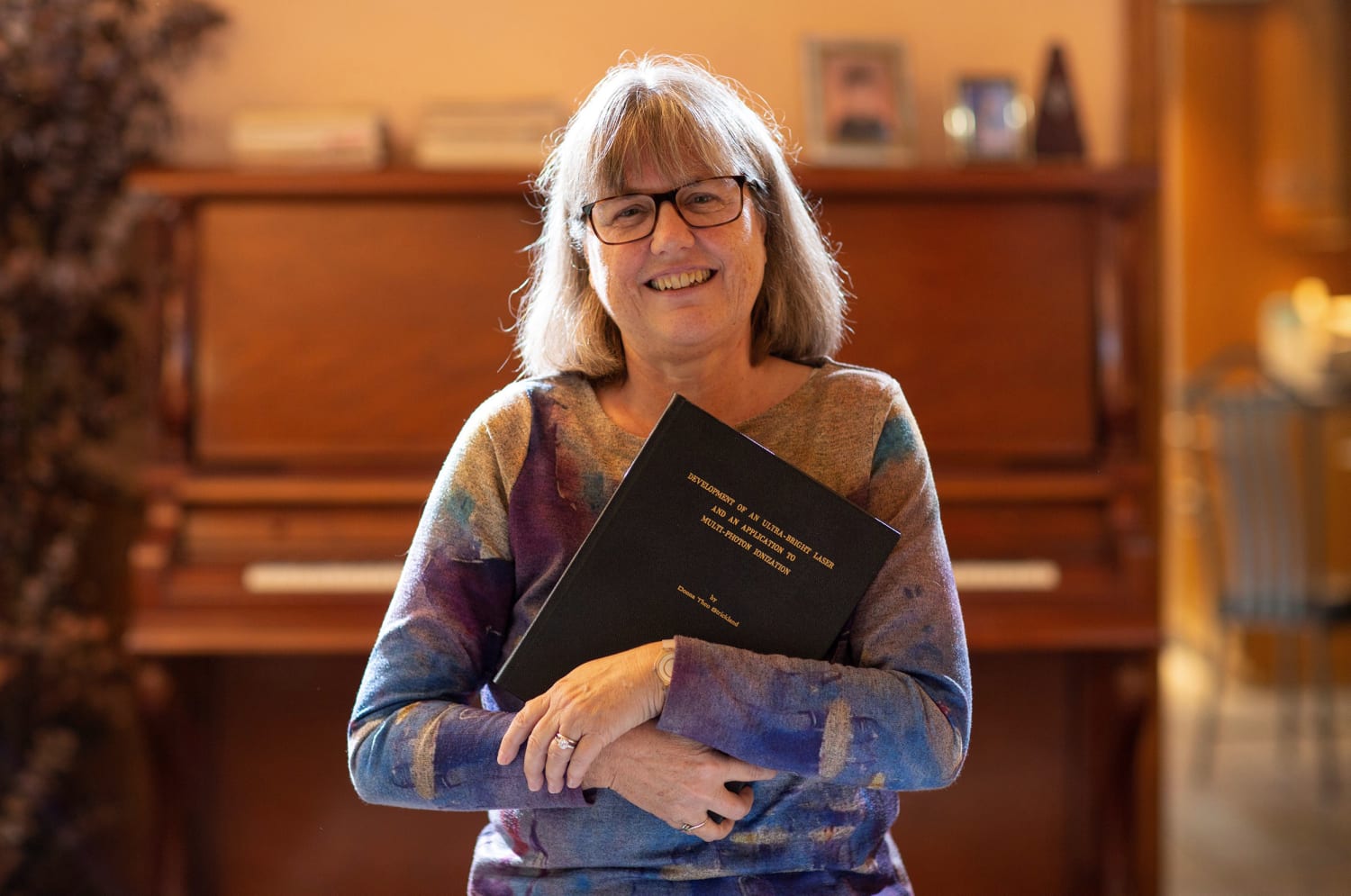
As secondary school teachers it's our job to promote and encourage students of all backgrounds, race, and gender to pursue whatever fields they want to; letting them know that they shouldn't be stopped because of stereotypes of a field (such as engineering is for men). I remember when I was volunteering at an elementary school we had a presentation from the UBC W
omen in Engineering (https://wie.engineering.ubc.ca/), "a faculty-supported student-run organization that promotes gender diversity, equity and inclusion in engineering". I didn't even know this club existed, but the presentation was engaging, inviting, and encouraged young students to not rule out possibilities because of their gender. A friend of mine gave the presentation and I thought it was really interesting and important for young women to have people they could look up to within fields they aren't typically represented; not only that but these were young people becoming engineers, not figure heads and historical figures to look back on, the members of this club were relatable and could connect with the students. I believe that bringing these groups and clubs into our classrooms to talk about their experiences, hardships, and successes can be inspirational for people to help guide their decisions. It's already hard enough to decide what to do when you entire university, I couldn't imagine how stereotypes could also affect decisions.
Much like in our 442 discussion on if Pythagoras was Chinese, we talked about how proper credit should be given to mathematicians that ancient Greeks are given all the credit for. Acknowledging these non-white males could allow students to feel more represented within the classroom and feel more of a connection to the works. Much like this talking point, we should do the same for women in STEM and underrepresented groups. We should acknowledge and give credit for their achievements and hardships.
Another way is to acknowledge important figure heads like Donna Strickland, while also being aware of her accomplishments we should also talk about her struggles to give a clear picture what challenges people may face in the STEM programs. As teachers we want to get rid of our biases and invite students to open their eyes to the world of possibilities that is within their grasp. We do not want to unconsciously push our students away from potentially joining the STEM fields by showing them it's male dominated, instead we should encourage our students to break those molds and create their own paths that will inspire many generations to come.
Subscribe to:
Posts (Atom)
Symbolic Worlds
Figured and Symbolic Worlds are all about what we interpret. The world, just like us, are constantly changing, and there are so many aspec...
-
I believe that mathematical terminology is an extremely important and useful tool that we as teachers will be using in the classroom. Terms ...
-
Link here: https://docs.google.com/presentation/d/1DNoQTmlf3FOGNYJaOP9IZeiPRXH01aCWqKlUQMl_ZMY/edit?usp=sharing
-
Name: Tyler Teaching specialty/specialties : Math Highlights of your teaching practicum experience : Experiences that you remember with ...

