
One section that really stood out to me in this article was the one on Large Numbers, and how there's an emotional disconnect between large numbers and how humans perceive them. The article states that "if we do not feel numbers, then our emotional access to the physical phenomena they represent is diminished" (Renert, 2011), and this is something I personally struggle with. I remember watching a video a couple years ago (there is profanity, so please watch it at your own discretion -- what 1 billion looks like - One billion dollars) that put into perspective just the idea of 1 billion, and it showed how it's hard to conceptualize that kind of number with the limited experience that I've had, let alone what an even larger number may feel like. I believe we may even have an understanding of the number, but to imagine a physical representation is almost impossible...I can say that I know there's around 40,000 students at UBC, but I can't tell anyone what 40,000 looks like. And I believe this connects to the classroom too: when we have less students in the classroom, we feel as if there's more of a connection with the teacher. When there are 30 students in the class, the teacher is able to recognize your name, face, and spend time with and connect with you emotionally; whereas in lecture halls, sometimes students feel as if they're just another number within the classroom.
A second idea that made me stop was the way that the article connected to a video we watched in class, specifically the portion of the TED talk presented by Stephen Wolfram. During the presentation he asks "What is math?" and mentions it's 4 steps: 1. Posing the Right questions 2. Real world --> Math formulation 3. Computation 4. Math formulation --> real world, verification . He mentions that we spend about 80% of the time learning step 3 by hand, but computers can do that faster and better than anyone. He also mentions we should let the computers do step 3 and put in more effort to do steps 1,2, and 4. This article and Wolfram's idea go hand in hand. Instead of focusing on the computational side of math, we can apply our knowledge to help pose the right question -- like how we can affectively combat climate change using math! The idea of sustainability is also already a real world situation, that can be explored through mathematics.
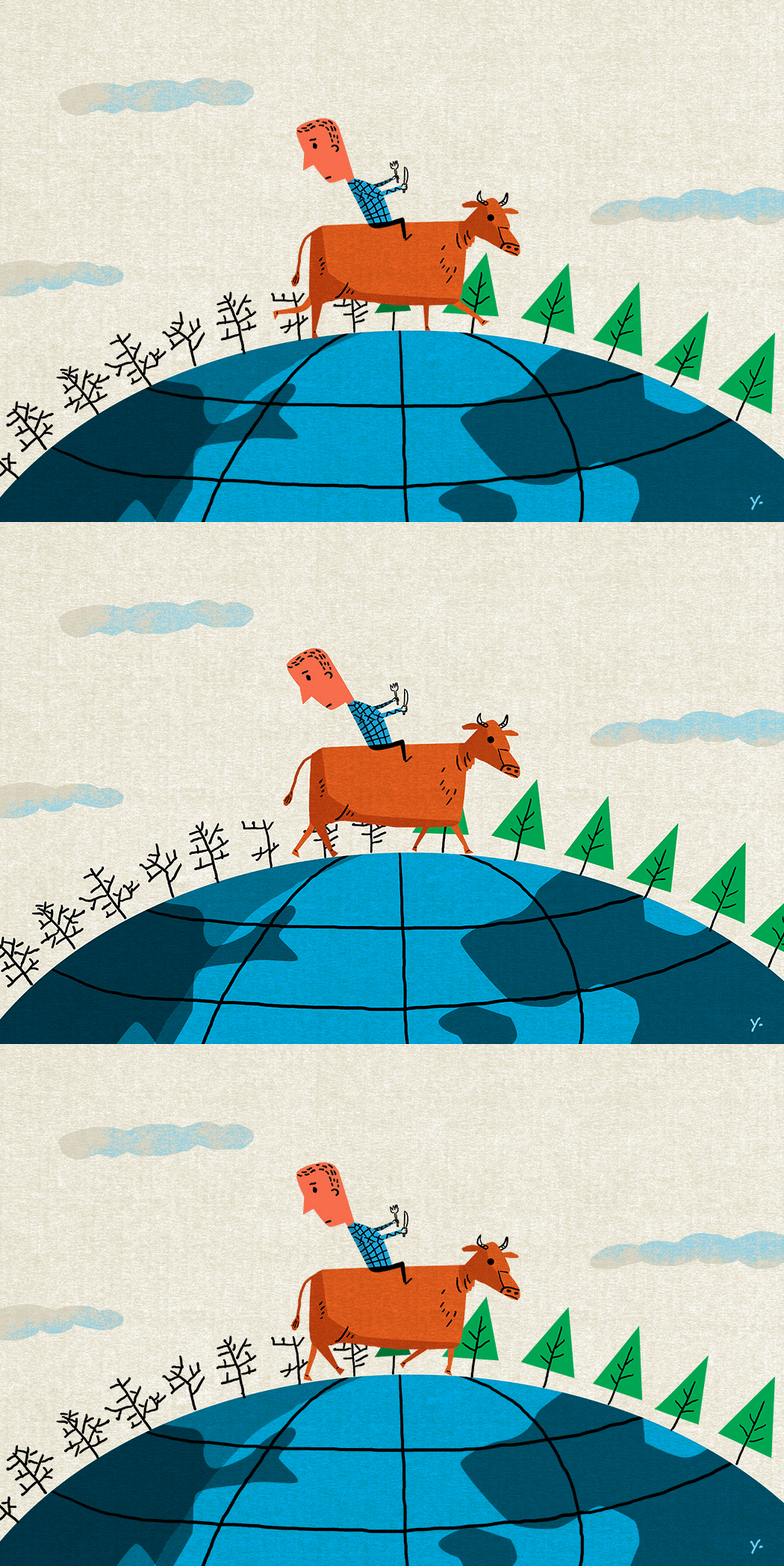
 I also think the idea of transdisciplinarity is an important one that can help make the learning of sustainability more holistic and easier for students to engage with. If we as math teachers present sustainability as an issue, using math problems to help see what reduces emissions and what is better for the Earth, the student may just see the problem as another word problem. They may look through the problem and just solve the question, which is counterproductive to our goal. Having intersectionality with other courses allows more engagement and different avenues to approach the problem, not just from a mathematics, or 'numerical' standpoint; it also allows teachers to ask different questions that can engage the student and think critically.



No comments:
Post a Comment